nbi
Neutral Beam Injection systems and description of the fast neutrals that arrive into the torus
Maximum occurrences (MDS+ backend only): 3
New in version 4.0.0: lifecycle status active
Changed in version 3.33.0.
ids_propertiesstructure
See common IDS structure reference: ids_properties.
unit(i1)AoS¶The NBI system is described as a set of units of which the power […] (click to expand)
The NBI system is described as a set of units of which the power can be controlled individually.
Maximum occurrences (MDS+ backend only): 32
1 |
|
unit(i1)/nameSTR_0D¶Short string identifier (unique for a given device)
Short string identifier (unique for a given device)
unit(i1)/descriptionSTR_0D¶Description, e.g. […] (click to expand)
Description, e.g. “channel viewing the upper divertor”
New in version >3.
unit(i1)/speciesstructure¶Injected species
Injected species
unit(i1)/power_launchedWstructure¶Power launched from this unit into the vacuum vessel
Power launched from this unit into the vacuum vessel
unit(i1)/energyeVstructure¶Full energy of the injected species (acceleration of a single […] (click to expand)
Full energy of the injected species (acceleration of a single atom)
unit(i1)/beam_current_fraction1structure¶Fractions of beam current distributed among the different energies, […] (click to expand)
Fractions of beam current distributed among the different energies, the first index corresponds to the fast neutrals energy (1:full, 2: half, 3: one third)
1 |
|
2 |
unit(i1)/beam_power_fraction1structure¶Fractions of beam power distributed among the different energies, […] (click to expand)
Fractions of beam power distributed among the different energies, the first index corresponds to the fast neutrals energy (1:full, 2: half, 3: one third)
1 |
|
2 |
unit(i1)/beamlets_group(i2)AoS¶Group of beamlets with common vertical and horizontal focal point. […] (click to expand)
Group of beamlets with common vertical and horizontal focal point. If there are no common focal points, then select small groups of beamlets such that a focal point description of the beamlets group provides a fair description. Beamlet groups are assumed to be Gaussian.
Maximum occurrences (MDS+ backend only): 16
1 |
|
unit(i1)/beamlets_group(i2)/positionstructure¶R, Z, Phi position of the beamlet group centre
R, Z, Phi position of the beamlet group centre
unit(i1)/beamlets_group(i2)/tangency_radius ⇹mFLT_0D¶Tangency radius (major radius where the central line of a NBI […] (click to expand)
Tangency radius (major radius where the central line of a NBI unit is tangent to a circle around the torus)
unit(i1)/beamlets_group(i2)/angle ⇹radFLT_0D¶Angle of inclination between a beamlet at the centre of the injection […] (click to expand)
Angle of inclination between a beamlet at the centre of the injection unit surface and the horiontal plane
unit(i1)/beamlets_group(i2)/tilting(itime)AoS¶In case of dynamic beam tilting (i.e. […] (click to expand)
In case of dynamic beam tilting (i.e. during the pulse), e.g. for some Beam Emission Spectroscopy use cases, variations of position, tangency radius and angle with respect to their static value, for various time slices
1 |
unit(i1)/beamlets_group(i2)/tilting(itime)/delta_positionstructure¶Variation of the position of the beamlet group centre
Variation of the position of the beamlet group centre
unit(i1)/beamlets_group(i2)/tilting(itime)/delta_tangency_radius ⇹mFLT_0D¶Variation of the tangency radius (major radius where the central […] (click to expand)
Variation of the tangency radius (major radius where the central line of a NBI unit is tangent to a circle around the torus)
unit(i1)/beamlets_group(i2)/directionINT_0D¶Direction of the beam seen from above the torus: -1 = clockwise; […] (click to expand)
Direction of the beam seen from above the torus: -1 = clockwise; 1 = counter clockwise
unit(i1)/beamlets_group(i2)/width_horizontal ⇹mFLT_0D¶Horizontal width (dimensions of the smallest rectangle that surrounds […] (click to expand)
Horizontal width (dimensions of the smallest rectangle that surrounds the outer dimensions of the beamlets) of the beamlet group at the injection unit surface (or grounded grid)
unit(i1)/beamlets_group(i2)/width_vertical ⇹mFLT_0D¶Vertical width (dimensions of the smallest rectangle that surrounds […] (click to expand)
Vertical width (dimensions of the smallest rectangle that surrounds the outer dimensions of the beamlets) of the beamlet group at the injection unit surface (or grounded grid)
unit(i1)/beamlets_group(i2)/focusstructure¶Describes how the beamlet group is focused. […] (click to expand)
Describes how the beamlet group is focused. Calculations of width_min_horizontal and width_min_vertical are on a plane defined by the average normal vector of the two constituent accelerator nbi target planes.
unit(i1)/beamlets_group(i2)/focus/focal_length_horizontal ⇹mFLT_0D¶Horizontal focal length along the beam line, i.e. […] (click to expand)
Horizontal focal length along the beam line, i.e. the point along the centre of the beamlet-group where the beamlet-group has its minimum horizontal width
unit(i1)/beamlets_group(i2)/focus/focal_length_vertical ⇹mFLT_0D¶Vertical focal length along the beam line, i.e. […] (click to expand)
Vertical focal length along the beam line, i.e. the point along the centre of the beamlet-group where the beamlet-group has its minimum vertical width
unit(i1)/beamlets_group(i2)/divergence_component(i3)AoS¶Detailed information on beamlet divergence. […] (click to expand)
Detailed information on beamlet divergence. Divergence is described as a superposition of Gaussian components with amplitide “particles_fraction” and vertical/horizontal divergence. Note that for positive ion NBI the divergence is well described by a single Gaussian
Maximum occurrences (MDS+ backend only): 3
1 |
|
unit(i1)/beamlets_group(i2)/divergence_component(i3)/particles_fraction ⇹1FLT_0D¶Fraction of injected particles in the component
Fraction of injected particles in the component
unit(i1)/beamlets_group(i2)/divergence_component(i3)/vertical ⇹radFLT_0D¶The vertical beamlet divergence of the component. […] (click to expand)
The vertical beamlet divergence of the component. Here the divergence is defined for Gaussian beams as the angle where the beam density is reduced by a factor 1/e compared to the maximum density (equivalent to the intensity for the divergence of each individual beamlet as the energy is assumed constant). For non-Gaussian beams the divergence is mean((x-mean(x))**2)/sqrt(2), where x is the angle and the mean should be performed over the beam density, P(x): mean(y)=int(y*P(x)*dx).
unit(i1)/beamlets_group(i2)/divergence_component(i3)/horizontal ⇹radFLT_0D¶The horiztonal beamlet divergence of the component. […] (click to expand)
The horiztonal beamlet divergence of the component. Here the divergence is defined for Gaussian beams as the angle where the beam density is reduced by a factor 1/e compared to the maximum density (equivalent to the intensity for the divergence of each individual beamlet as the energy is assumed constant). For non-Gaussian beams the divergence is mean((x-mean(x))**2)/sqrt(2), where x is the angle and the mean should be performed over the beam density, P(x): mean(y)=int(y*P(x)*dx).
unit(i1)/beamlets_group(i2)/beamletsstructure¶Detailed information on beamlets
Detailed information on beamlets
unit(i1)/beamlets_group(i2)/beamlets/positionsstructure¶Position of each beamlet
Position of each beamlet
unit(i1)/beamlets_group(i2)/beamlets/positions/phi(:) ⇹radFLT_1D¶Toroidal angle (oriented counter-clockwise when viewing from […] (click to expand)
Toroidal angle (oriented counter-clockwise when viewing from above)
1 |
unit(i1)/beamlets_group(i2)/beamlets/tangency_radii(:) ⇹mFLT_1D¶Tangency radius (major radius where the central line of a beamlet […] (click to expand)
Tangency radius (major radius where the central line of a beamlet is tangent to a circle around the torus), for each beamlet
1 |
unit(i1)/beamlets_group(i2)/beamlets/angles(:) ⇹radFLT_1D¶Angle of inclination between a line at the centre of a beamlet […] (click to expand)
Angle of inclination between a line at the centre of a beamlet and the horizontal plane, for each beamlet
1 |
unit(i1)/sourcestructure¶Description of the surface of the ion source from which the beam […] (click to expand)
Description of the surface of the ion source from which the beam is extracted
unit(i1)/source/geometry_typeINT_0D¶Type of geometry used to describe the surface of the detector […] (click to expand)
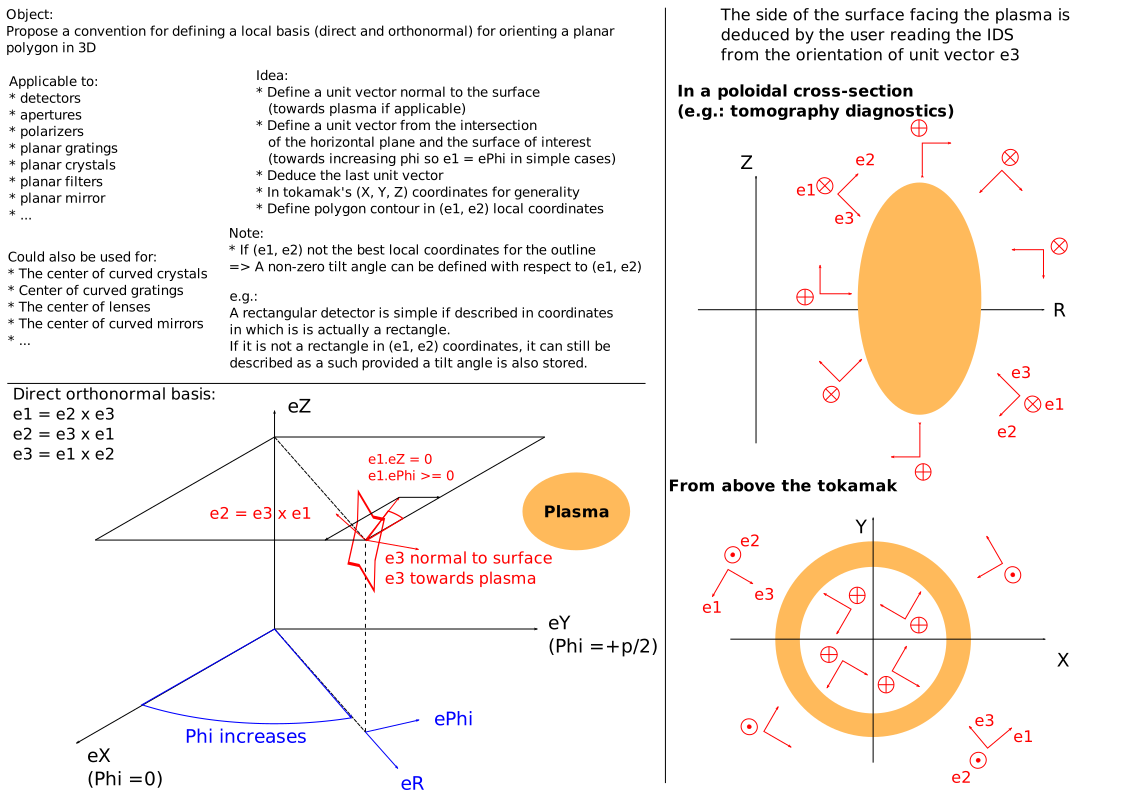
Type of geometry used to describe the surface of the detector or aperture (1:’outline’, 2:’circular’, 3:’rectangle’). In case of ‘outline’, the surface is described by an outline of point in a local coordinate system defined by a centre and three unit vectors X1, X2, X3. Note that there is some flexibility here and the data provider should choose the most convenient coordinate system for the object, respecting the definitions of (X1,X2,X3) indicated below. In case of ‘circular’, the surface is a circle defined by its centre, radius, and normal vector oriented towards the plasma X3. In case of ‘rectangle’, the surface is a rectangle defined by its centre, widths in the X1 and X2 directions, and normal vector oriented towards the plasma X3.
unit(i1)/source/centrestructure¶If geometry_type=2, coordinates of the centre of the circle. […] (click to expand)
If geometry_type=2, coordinates of the centre of the circle. If geometry_type=1 or 3, coordinates of the origin of the local coordinate system (X1,X2,X3) describing the plane detector/aperture. This origin is located within the detector/aperture area.
unit(i1)/source/radius ⇹mFLT_0D¶Radius of the circle, used only if geometry_type = 2
Radius of the circle, used only if geometry_type = 2
unit(i1)/source/x1_unit_vectorstructure¶Components of the X1 direction unit vector in the (X,Y,Z) coordinate […] (click to expand)
Components of the X1 direction unit vector in the (X,Y,Z) coordinate system, where X is the major radius axis for phi = 0, Y is the major radius axis for phi = pi/2, and Z is the height axis. The X1 vector is more horizontal than X2 (has a smaller abs(Z) component) and oriented in the positive phi direction (counter-clockwise when viewing from above).
unit(i1)/source/x2_unit_vectorstructure¶Components of the X2 direction unit vector in the (X,Y,Z) coordinate […] (click to expand)
Components of the X2 direction unit vector in the (X,Y,Z) coordinate system, where X is the major radius axis for phi = 0, Y is the major radius axis for phi = pi/2, and Z is the height axis. The X2 axis is orthonormal so that uX2 = uX3 x uX1.
unit(i1)/source/x3_unit_vectorstructure¶Components of the X3 direction unit vector in the (X,Y,Z) coordinate […] (click to expand)
Components of the X3 direction unit vector in the (X,Y,Z) coordinate system, where X is the major radius axis for phi = 0, Y is the major radius axis for phi = pi/2, and Z is the height axis. The X3 axis is normal to the detector/aperture plane and oriented towards the plasma.
unit(i1)/source/x1_width ⇹mFLT_0D¶Full width of the aperture in the X1 direction, used only if […] (click to expand)
Full width of the aperture in the X1 direction, used only if geometry_type = 3
unit(i1)/source/x2_width ⇹mFLT_0D¶Full width of the aperture in the X2 direction, used only if […] (click to expand)
Full width of the aperture in the X2 direction, used only if geometry_type = 3
unit(i1)/source/outlinestructure¶Irregular outline of the detector/aperture in the (X1, X2) coordinate […] (click to expand)
Irregular outline of the detector/aperture in the (X1, X2) coordinate system. Repeat the first point since this is a closed contour
Changed in version 4: Since this describes a closed countour first point must now be repeated at the end of the coordinate arrays of the children
unit(i1)/aperture(i2)AoS¶Description of a set of collimating apertures through which the […] (click to expand)
Description of a set of collimating apertures through which the beam is launched
Maximum occurrences (MDS+ backend only): 5
1 |
|
unit(i1)/aperture(i2)/geometry_typeINT_0D¶Type of geometry used to describe the surface of the detector […] (click to expand)
Type of geometry used to describe the surface of the detector or aperture (1:’outline’, 2:’circular’, 3:’rectangle’). In case of ‘outline’, the surface is described by an outline of point in a local coordinate system defined by a centre and three unit vectors X1, X2, X3. Note that there is some flexibility here and the data provider should choose the most convenient coordinate system for the object, respecting the definitions of (X1,X2,X3) indicated below. In case of ‘circular’, the surface is a circle defined by its centre, radius, and normal vector oriented towards the plasma X3. In case of ‘rectangle’, the surface is a rectangle defined by its centre, widths in the X1 and X2 directions, and normal vector oriented towards the plasma X3.
unit(i1)/aperture(i2)/centrestructure¶If geometry_type=2, coordinates of the centre of the circle. […] (click to expand)
If geometry_type=2, coordinates of the centre of the circle. If geometry_type=1 or 3, coordinates of the origin of the local coordinate system (X1,X2,X3) describing the plane detector/aperture. This origin is located within the detector/aperture area.
unit(i1)/aperture(i2)/radius ⇹mFLT_0D¶Radius of the circle, used only if geometry_type = 2
Radius of the circle, used only if geometry_type = 2
unit(i1)/aperture(i2)/x1_unit_vectorstructure¶Components of the X1 direction unit vector in the (X,Y,Z) coordinate […] (click to expand)
Components of the X1 direction unit vector in the (X,Y,Z) coordinate system, where X is the major radius axis for phi = 0, Y is the major radius axis for phi = pi/2, and Z is the height axis. The X1 vector is more horizontal than X2 (has a smaller abs(Z) component) and oriented in the positive phi direction (counter-clockwise when viewing from above).
unit(i1)/aperture(i2)/x2_unit_vectorstructure¶Components of the X2 direction unit vector in the (X,Y,Z) coordinate […] (click to expand)
Components of the X2 direction unit vector in the (X,Y,Z) coordinate system, where X is the major radius axis for phi = 0, Y is the major radius axis for phi = pi/2, and Z is the height axis. The X2 axis is orthonormal so that uX2 = uX3 x uX1.
unit(i1)/aperture(i2)/x3_unit_vectorstructure¶Components of the X3 direction unit vector in the (X,Y,Z) coordinate […] (click to expand)
Components of the X3 direction unit vector in the (X,Y,Z) coordinate system, where X is the major radius axis for phi = 0, Y is the major radius axis for phi = pi/2, and Z is the height axis. The X3 axis is normal to the detector/aperture plane and oriented towards the plasma.
unit(i1)/aperture(i2)/x1_width ⇹mFLT_0D¶Full width of the aperture in the X1 direction, used only if […] (click to expand)
Full width of the aperture in the X1 direction, used only if geometry_type = 3
unit(i1)/aperture(i2)/x2_width ⇹mFLT_0D¶Full width of the aperture in the X2 direction, used only if […] (click to expand)
Full width of the aperture in the X2 direction, used only if geometry_type = 3
unit(i1)/aperture(i2)/outlinestructure¶Irregular outline of the detector/aperture in the (X1, X2) coordinate […] (click to expand)
Irregular outline of the detector/aperture in the (X1, X2) coordinate system. Repeat the first point since this is a closed contour
Changed in version 4: Since this describes a closed countour first point must now be repeated at the end of the coordinate arrays of the children
unit(i1)/aperture(i2)/outline/x1(:) ⇹mFLT_1D¶Positions along x1 axis
Positions along x1 axis
1 |
|
latency ⇹sFLT_0D¶Upper bound of the delay between input command received from […] (click to expand)
Upper bound of the delay between input command received from the RT network and actuator starting to react. Applies globally to the system described by this IDS unless specific latencies (e.g. channel-specific or antenna-specific) are provided at a deeper level in the IDS structure.
New in version >3.32.1.