spectrometer_uv
Spectrometer in uv light range diagnostic
Maximum occurrences (MDS+ backend only): 2
New in version 3.29.0: lifecycle status alpha
Changed in version 3.42.0.
ids_propertiesstructure
See common IDS structure reference: ids_properties.
etendue ⇹m^2.srFLT_0D¶Etendue (geometric extent) of the optical system
Etendue (geometric extent) of the optical system
etendue_methodstructure¶Method used to calculate the etendue. […] (click to expand)
Method used to calculate the etendue. Index = 0 : exact calculation with a 4D integral; 1 : approximation with first order formula (detector surface times solid angle subtended by the apertures); 2 : other methods
channel(i1)AoS¶Set of channels (detector or pixel of a camera)
Set of channels (detector or pixel of a camera)
Maximum occurrences (MDS+ backend only): 10
1 |
|
channel(i1)/detector_layoutstructure¶Dimensions of pixels and detector
Dimensions of pixels and detector
channel(i1)/detector_layout/pixel_dimensions(:) ⇹mFLT_1D¶Pixel dimension in each direction (horizontal, vertical)
Pixel dimension in each direction (horizontal, vertical)
1 |
|
channel(i1)/detector_layout/pixel_n(:)INT_1D¶Number of pixels in each direction (horizontal, vertical)
Number of pixels in each direction (horizontal, vertical)
1 |
|
channel(i1)/detectorstructure¶Description of the front face of the micro channel plate
Description of the front face of the micro channel plate
channel(i1)/detector/geometry_typeINT_0D¶Type of geometry used to describe the surface of the detector […] (click to expand)
Type of geometry used to describe the surface of the detector or aperture (1:’outline’, 2:’circular’, 3:’rectangle’). In case of ‘outline’, the surface is described by an outline of point in a local coordinate system defined by a centre and three unit vectors X1, X2, X3. Note that there is some flexibility here and the data provider should choose the most convenient coordinate system for the object, respecting the definitions of (X1,X2,X3) indicated below. In case of ‘circular’, the surface is a circle defined by its centre, radius, and normal vector oriented towards the plasma X3. In case of ‘rectangle’, the surface is a rectangle defined by its centre, widths in the X1 and X2 directions, and normal vector oriented towards the plasma X3.
channel(i1)/detector/centrestructure¶If geometry_type=2, coordinates of the centre of the circle. […] (click to expand)
If geometry_type=2, coordinates of the centre of the circle. If geometry_type=1 or 3, coordinates of the origin of the local coordinate system (X1,X2,X3) describing the plane detector/aperture. This origin is located within the detector/aperture area.
channel(i1)/detector/radius ⇹mFLT_0D¶Radius of the circle, used only if geometry_type = 2
Radius of the circle, used only if geometry_type = 2
channel(i1)/detector/x1_unit_vectorstructure¶Components of the X1 direction unit vector in the (X,Y,Z) coordinate […] (click to expand)
Components of the X1 direction unit vector in the (X,Y,Z) coordinate system, where X is the major radius axis for phi = 0, Y is the major radius axis for phi = pi/2, and Z is the height axis. The X1 vector is more horizontal than X2 (has a smaller abs(Z) component) and oriented in the positive phi direction (counter-clockwise when viewing from above).
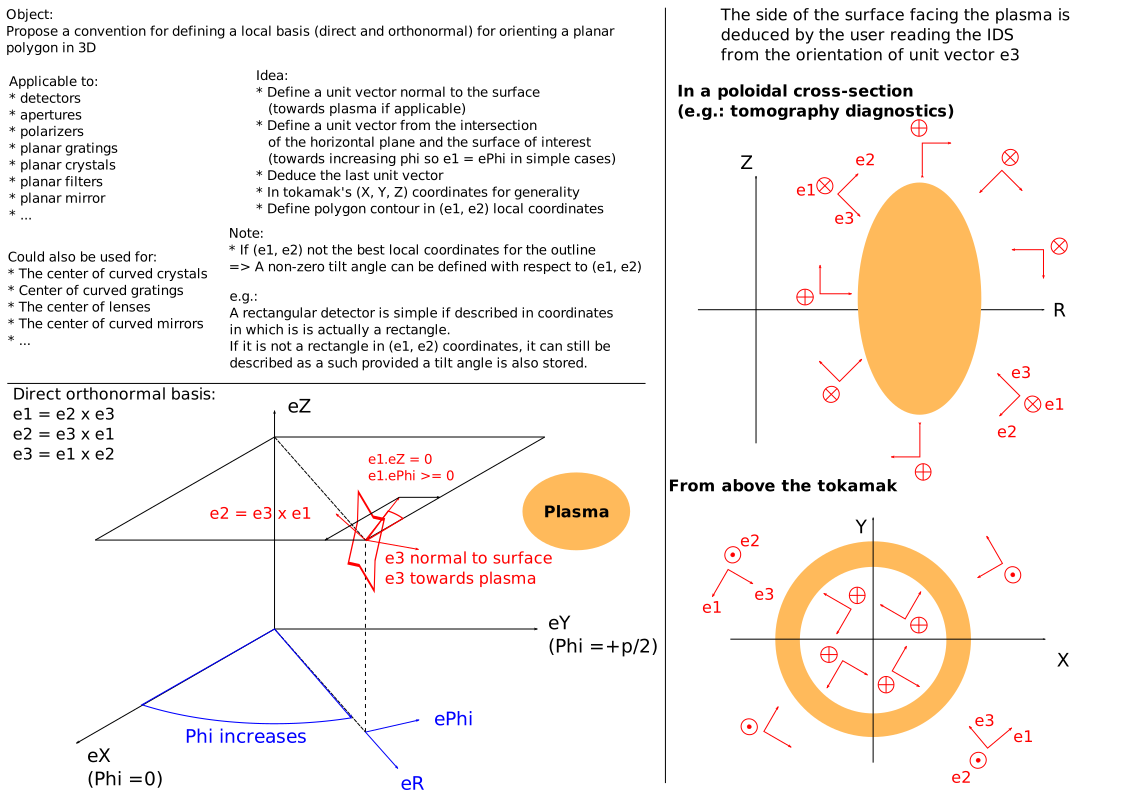
channel(i1)/detector/x2_unit_vectorstructure¶Components of the X2 direction unit vector in the (X,Y,Z) coordinate […] (click to expand)
Components of the X2 direction unit vector in the (X,Y,Z) coordinate system, where X is the major radius axis for phi = 0, Y is the major radius axis for phi = pi/2, and Z is the height axis. The X2 axis is orthonormal so that uX2 = uX3 x uX1.
channel(i1)/detector/x3_unit_vectorstructure¶Components of the X3 direction unit vector in the (X,Y,Z) coordinate […] (click to expand)
Components of the X3 direction unit vector in the (X,Y,Z) coordinate system, where X is the major radius axis for phi = 0, Y is the major radius axis for phi = pi/2, and Z is the height axis. The X3 axis is normal to the detector/aperture plane and oriented towards the plasma.
channel(i1)/detector/x1_width ⇹mFLT_0D¶Full width of the aperture in the X1 direction, used only if […] (click to expand)
Full width of the aperture in the X1 direction, used only if geometry_type = 3
channel(i1)/detector/x2_width ⇹mFLT_0D¶Full width of the aperture in the X2 direction, used only if […] (click to expand)
Full width of the aperture in the X2 direction, used only if geometry_type = 3
channel(i1)/detector/outlinestructure¶Irregular outline of the detector/aperture in the (X1, X2) coordinate […] (click to expand)
Irregular outline of the detector/aperture in the (X1, X2) coordinate system. Repeat the first point since this is a closed contour
Changed in version 4: Since this describes a closed countour first point must now be repeated at the end of the coordinate arrays of the children
channel(i1)/detector_position_parametermixedstructure¶In case of detector moving during a pulse, position parameter […] (click to expand)
In case of detector moving during a pulse, position parameter allowing to record and compute the detector position as a function of time
channel(i1)/aperture(i2)AoS¶Description of a set of collimating apertures
Description of a set of collimating apertures
Maximum occurrences (MDS+ backend only): 5
1 |
|
channel(i1)/aperture(i2)/geometry_typeINT_0D¶Type of geometry used to describe the surface of the detector […] (click to expand)
Type of geometry used to describe the surface of the detector or aperture (1:’outline’, 2:’circular’, 3:’rectangle’). In case of ‘outline’, the surface is described by an outline of point in a local coordinate system defined by a centre and three unit vectors X1, X2, X3. Note that there is some flexibility here and the data provider should choose the most convenient coordinate system for the object, respecting the definitions of (X1,X2,X3) indicated below. In case of ‘circular’, the surface is a circle defined by its centre, radius, and normal vector oriented towards the plasma X3. In case of ‘rectangle’, the surface is a rectangle defined by its centre, widths in the X1 and X2 directions, and normal vector oriented towards the plasma X3.
channel(i1)/aperture(i2)/centrestructure¶If geometry_type=2, coordinates of the centre of the circle. […] (click to expand)
If geometry_type=2, coordinates of the centre of the circle. If geometry_type=1 or 3, coordinates of the origin of the local coordinate system (X1,X2,X3) describing the plane detector/aperture. This origin is located within the detector/aperture area.
channel(i1)/aperture(i2)/radius ⇹mFLT_0D¶Radius of the circle, used only if geometry_type = 2
Radius of the circle, used only if geometry_type = 2
channel(i1)/aperture(i2)/x1_unit_vectorstructure¶Components of the X1 direction unit vector in the (X,Y,Z) coordinate […] (click to expand)
Components of the X1 direction unit vector in the (X,Y,Z) coordinate system, where X is the major radius axis for phi = 0, Y is the major radius axis for phi = pi/2, and Z is the height axis. The X1 vector is more horizontal than X2 (has a smaller abs(Z) component) and oriented in the positive phi direction (counter-clockwise when viewing from above).
channel(i1)/aperture(i2)/x2_unit_vectorstructure¶Components of the X2 direction unit vector in the (X,Y,Z) coordinate […] (click to expand)
Components of the X2 direction unit vector in the (X,Y,Z) coordinate system, where X is the major radius axis for phi = 0, Y is the major radius axis for phi = pi/2, and Z is the height axis. The X2 axis is orthonormal so that uX2 = uX3 x uX1.
channel(i1)/aperture(i2)/x3_unit_vectorstructure¶Components of the X3 direction unit vector in the (X,Y,Z) coordinate […] (click to expand)
Components of the X3 direction unit vector in the (X,Y,Z) coordinate system, where X is the major radius axis for phi = 0, Y is the major radius axis for phi = pi/2, and Z is the height axis. The X3 axis is normal to the detector/aperture plane and oriented towards the plasma.
channel(i1)/aperture(i2)/x1_width ⇹mFLT_0D¶Full width of the aperture in the X1 direction, used only if […] (click to expand)
Full width of the aperture in the X1 direction, used only if geometry_type = 3
channel(i1)/aperture(i2)/x2_width ⇹mFLT_0D¶Full width of the aperture in the X2 direction, used only if […] (click to expand)
Full width of the aperture in the X2 direction, used only if geometry_type = 3
channel(i1)/aperture(i2)/outlinestructure¶Irregular outline of the detector/aperture in the (X1, X2) coordinate […] (click to expand)
Irregular outline of the detector/aperture in the (X1, X2) coordinate system. Repeat the first point since this is a closed contour
Changed in version 4: Since this describes a closed countour first point must now be repeated at the end of the coordinate arrays of the children
channel(i1)/aperture(i2)/outline/x1(:) ⇹mFLT_1D¶Positions along x1 axis
Positions along x1 axis
1 |
|
channel(i1)/line_of_sightstructure¶Description of the line of sight of the channel, given by 2 points. […] (click to expand)
Description of the line of sight of the channel, given by 2 points. The 2nd point is allowed to evolve in case of dynamic line of sight.
channel(i1)/line_of_sight/first_pointstructure¶Position of the first point
Position of the first point
channel(i1)/line_of_sight/second_pointstructure¶Position of the second point (possibly dynamic)
Position of the second point (possibly dynamic)
channel(i1)/line_of_sight/moving_modestructure¶Moving mode of the line of sight. […] (click to expand)
Moving mode of the line of sight. Index = 0 : no movement, fixed position. Index = 1 : oscillating
channel(i1)/line_of_sight/position_parametermixedstructure¶In case of line of sight moving during a pulse, position parameter […] (click to expand)
In case of line of sight moving during a pulse, position parameter allowing to record and compute the line of sight position as a function of time
channel(i1)/supply_high_voltage(i2)AoS¶Set of high voltage power supplies applied to various parts of […] (click to expand)
Set of high voltage power supplies applied to various parts of the diagnostic
Maximum occurrences (MDS+ backend only): 2
1 |
|
channel(i1)/supply_high_voltage(i2)/objectSTR_0D¶Name of the object connected to the power supply
Name of the object connected to the power supply
channel(i1)/gratingstructure¶Description of the grating
Description of the grating
channel(i1)/grating/typestructure¶Grating type. […] (click to expand)
Grating type. Index = 1 : ruled. Index = 2 : holographic
channel(i1)/grating/groove_density ⇹m^-1FLT_0D¶Number of grooves per unit length
Number of grooves per unit length
channel(i1)/grating/geometry_typestructure¶Grating geometry. […] (click to expand)
Grating geometry. Index = 1 : spherical. Index = 2 : toric
channel(i1)/grating/centrestructure¶Centre of the grating sphere (if grating is spherical) or torus […] (click to expand)
Centre of the grating sphere (if grating is spherical) or torus (if grating is toric)
channel(i1)/grating/curvature_radius ⇹mFLT_0D¶Curvature radius of the spherical grating
Curvature radius of the spherical grating
channel(i1)/grating/summitstructure¶Position of the grating summit (defined as the point of contact […] (click to expand)
Position of the grating summit (defined as the point of contact of its concave side if the grating were put on a table). Used as the origin of the x1, x2, x3 vectors defined below
channel(i1)/grating/x1_unit_vectorstructure¶Components of the X1 direction unit vector in the (X,Y,Z) coordinate […] (click to expand)
Components of the X1 direction unit vector in the (X,Y,Z) coordinate system, where X is the major radius axis for phi = 0, Y is the major radius axis for phi = pi/2, and Z is the height axis. The X1 vector is horizontal and oriented in the positive phi direction (counter-clockwise when viewing from above).
channel(i1)/grating/x2_unit_vectorstructure¶Components of the X2 direction unit vector in the (X,Y,Z) coordinate […] (click to expand)
Components of the X2 direction unit vector in the (X,Y,Z) coordinate system, where X is the major radius axis for phi = 0, Y is the major radius axis for phi = pi/2, and Z is the height axis. The X2 axis is orthonormal so that uX2 = uX3 x uX1.
channel(i1)/grating/x3_unit_vectorstructure¶Components of the X3 direction unit vector in the (X,Y,Z) coordinate […] (click to expand)
Components of the X3 direction unit vector in the (X,Y,Z) coordinate system, where X is the major radius axis for phi = 0, Y is the major radius axis for phi = pi/2, and Z is the height axis. The X3 axis is normal to the grating at its summit and oriented towards the plasma.
channel(i1)/grating/outlinestructure¶List of the 4 extreme points of the spherical grating in the […] (click to expand)
List of the 4 extreme points of the spherical grating in the (X1, X2) coordinate system, using the summit as the origin. Repeat the first point since this is a closed contour
Changed in version 4: Since this describes a closed countour first point must now be repeated at the end of the coordinate arrays of the children
channel(i1)/grating/image_fieldstructure¶Surface on which the grating image is focused
Surface on which the grating image is focused
channel(i1)/grating/image_field/geometry_typestructure¶Surface geometry. […] (click to expand)
Surface geometry. Index = 1 : spherical. Index = 2 : plane
channel(i1)/grating/image_field/geometry_type/nameSTR_0D¶Short string identifier
Short string identifier
channel(i1)/grating/image_field/centrestructure¶Centre of the image surface in case it is spherical, or position […] (click to expand)
Centre of the image surface in case it is spherical, or position of a point on the surface in case it is a plane
channel(i1)/grating/image_field/curvature_radius ⇹mFLT_0D¶Curvature radius of the image surface
Curvature radius of the image surface
channel(i1)/grating/image_field/x3_unit_vectorstructure¶Components of the X3 direction unit vector in the (X,Y,Z) coordinate […] (click to expand)
Components of the X3 direction unit vector in the (X,Y,Z) coordinate system, where X is the major radius axis for phi = 0, Y is the major radius axis for phi = pi/2, and Z is the height axis. The X3 axis is normal to the surface ( in case it is plane) and oriented towards the plasma.
channel(i1)/grating/image_field/x3_unit_vector/x ⇹mFLT_0D¶Component along X axis
Component along X axis
channel(i1)/radiance_spectralm^-2.s^-1.sr^-1.m^-1structure¶Calibrated spectral radiance (radiance per unit wavelength)
Calibrated spectral radiance (radiance per unit wavelength)
1 |
|
2 |
channel(i1)/intensity_spectrums^-1structure¶Intensity spectrum (not calibrated), i.e. […] (click to expand)
Intensity spectrum (not calibrated), i.e. number of photoelectrons detected by unit time by a wavelength pixel of the channel, taking into account electronic gain compensation and channels relative calibration
1 |
|
2 |
channel(i1)/processed_line(i2)AoS¶Set of processed spectral lines
Set of processed spectral lines
Maximum occurrences (MDS+ backend only): 20
1 |
|
channel(i1)/processed_line(i2)/nameSTR_0D¶String identifying the processed line. […] (click to expand)
String identifying the processed line. To avoid ambiguities, the following syntax is used : element with ionization state_wavelength in Angstrom (e.g. WI_4000)
Changed in version 3.42.0: Renamed from label
channel(i1)/processed_line(i2)/wavelength_central ⇹mFLT_0D¶Central wavelength of the processed line
Central wavelength of the processed line
channel(i1)/processed_line(i2)/radiancem^-2.s^-1.sr^-1structure¶Calibrated, background subtracted radiance (integrated over the […] (click to expand)
Calibrated, background subtracted radiance (integrated over the spectrum for this line)
channel(i1)/radiance_calibration_dateSTR_0D¶Date of the radiance calibration (yyyy_mm_dd)
Date of the radiance calibration (yyyy_mm_dd)
channel(i1)/wavelength_calibrationstructure¶Wavelength calibration data. […] (click to expand)
Wavelength calibration data. The wavelength is obtained from the pixel index k by: wavelength = k * gain + offset. k is starting from 1.
channel(i1)/wavelength_calibration_dateSTR_0D¶Date of the wavelength calibration (yyyy_mm_dd)
Date of the wavelength calibration (yyyy_mm_dd)
channel(i1)/validity_timedstructure¶Indicator of the validity of the data for each wavelength and […] (click to expand)
Indicator of the validity of the data for each wavelength and each time slice. 0: valid from automated processing, 1: valid and certified by the diagnostic RO; - 1 means problem identified in the data processing (request verification by the diagnostic RO), -2: invalid data, should not be used (values lower than -2 have a code-specific meaning detailing the origin of their invalidity)
1 |
channel(i1)/validityINT_0D¶Indicator of the validity of the data for the whole acquisition […] (click to expand)
Indicator of the validity of the data for the whole acquisition period. 0: valid from automated processing, 1: valid and certified by the diagnostic RO; - 1 means problem identified in the data processing (request verification by the diagnostic RO), -2: invalid data, should not be used (values lower than -2 have a code-specific meaning detailing the origin of their invalidity)