pf_passive
Description of the axisymmetric passive conductors, currents flowing in them. Electromagnetic simulations are expected to use only this IDS to describe passive conductors and their specific discretization, not the component-related IDS (e.g. wall) which are used to store e.g. the component machine description
Maximum occurrences (MDS+ backend only): 3
New in version 3.0.0: lifecycle status alpha
Changed in version 3.37.0.
ids_propertiesstructure
See common IDS structure reference: ids_properties.
loop(i1)AoS¶Passive axisymmetric conductor description in the form of non-connected […] (click to expand)
Passive axisymmetric conductor description in the form of non-connected loops; any connected loops are expressed as active coil circuits with no power supply attached.
Maximum occurrences (MDS+ backend only): 500
1 |
|
loop(i1)/nameSTR_0D¶Short string identifier (unique for a given device)
Short string identifier (unique for a given device)
loop(i1)/descriptionSTR_0D¶Description, e.g. […] (click to expand)
Description, e.g. “channel viewing the upper divertor”
New in version >3.
loop(i1)/element(i2)AoS¶Each loop is comprised of a number of cross-section elements […] (click to expand)
Each loop is comprised of a number of cross-section elements described individually
Maximum occurrences (MDS+ backend only): 20
1 |
|
loop(i1)/element(i2)/nameSTR_0D¶Short string identifier (unique for a given device)
Short string identifier (unique for a given device)
loop(i1)/element(i2)/descriptionSTR_0D¶Description, e.g. […] (click to expand)
Description, e.g. “channel viewing the upper divertor”
New in version >3.
loop(i1)/element(i2)/turns_with_sign ⇹1FLT_0D¶Number of effective turns in the element for calculating the […] (click to expand)
Number of effective turns in the element for calculating the magnetic field from the coil/loop. Should be positive, unless the coil has elements going in opposite directions.
loop(i1)/element(i2)/area ⇹m^2FLT_0D¶Cross-sectional areas of the element
Cross-sectional areas of the element
loop(i1)/element(i2)/geometrystructure¶Cross-sectional shape of the element
Cross-sectional shape of the element
loop(i1)/element(i2)/geometry/geometry_typeINT_0D¶Type used to describe the element shape (1:’outline’, 2:’rectangle’, […] (click to expand)
Type used to describe the element shape (1:’outline’, 2:’rectangle’, 3:’oblique’, 4:’arcs of circle, 5: ‘annulus’, 6 : ‘thick line’)
loop(i1)/element(i2)/geometry/outlinestructure¶Irregular outline of the element. […] (click to expand)
Irregular outline of the element. Repeat the first point since this is a closed contour
Changed in version 4: Since this describes a closed countour first point must now be repeated at the end of the coordinate arrays of the children
loop(i1)/element(i2)/geometry/rectanglestructure¶Rectangular description of the element
Rectangular description of the element
loop(i1)/element(i2)/geometry/obliquestructure¶Parallelogram description of the element
Parallelogram description of the element
loop(i1)/element(i2)/geometry/oblique/r ⇹mFLT_0D¶Major radius of the reference point (from which the alpha and […] (click to expand)
Major radius of the reference point (from which the alpha and beta angles are defined, marked by a + on the diagram)
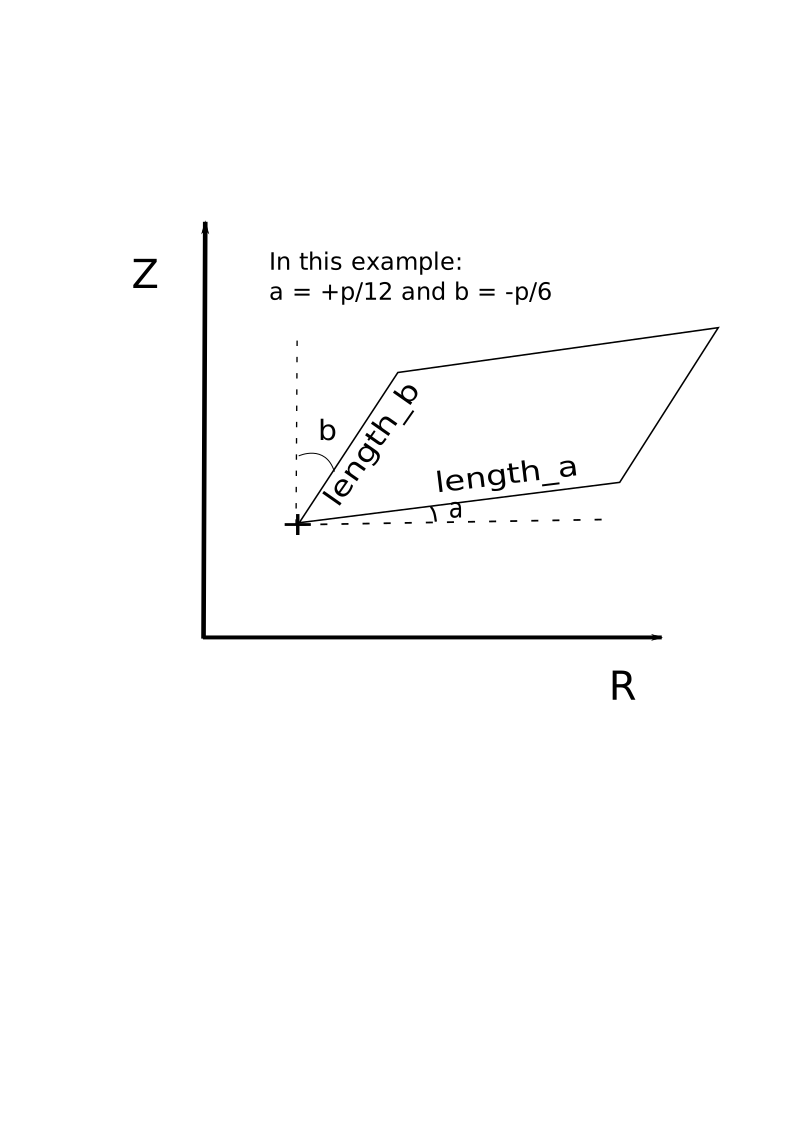
loop(i1)/element(i2)/geometry/oblique/z ⇹mFLT_0D¶Height of the reference point (from which the alpha and beta […] (click to expand)
Height of the reference point (from which the alpha and beta angles are defined, marked by a + on the diagram)
loop(i1)/element(i2)/geometry/oblique/length_alpha ⇹mFLT_0D¶Length of the parallelogram side inclined with angle alpha with […] (click to expand)
Length of the parallelogram side inclined with angle alpha with respect to the major radius axis
loop(i1)/element(i2)/geometry/oblique/length_beta ⇹mFLT_0D¶Length of the parallelogram side inclined with angle beta with […] (click to expand)
Length of the parallelogram side inclined with angle beta with respect to the height axis
loop(i1)/element(i2)/geometry/oblique/alpha ⇹radFLT_0D¶Inclination of first angle measured counter-clockwise from horizontal […] (click to expand)
Inclination of first angle measured counter-clockwise from horizontal outwardly directed radial vector (grad R).
loop(i1)/element(i2)/geometry/oblique/beta ⇹radFLT_0D¶Inclination of second angle measured counter-clockwise from vertically […] (click to expand)
Inclination of second angle measured counter-clockwise from vertically upwards directed vector (grad Z). If both alpha and beta are zero (rectangle) then the simpler rectangular elements description should be used.
loop(i1)/element(i2)/geometry/arcs_of_circlestructure¶Description of the element contour by a set of arcs of circle. […] (click to expand)
Description of the element contour by a set of arcs of circle. For each of these, the position of the start point is given together with the curvature radius. The end point is given by the start point of the next arc of circle.
loop(i1)/element(i2)/geometry/arcs_of_circle/r(:) ⇹mFLT_1D¶Major radii of the start point of each arc of circle
Major radii of the start point of each arc of circle
1 |
|
loop(i1)/element(i2)/geometry/arcs_of_circle/z(:) ⇹mFLT_1D¶Height of the start point of each arc of circle
Height of the start point of each arc of circle
1 |
loop(i1)/element(i2)/geometry/annulusstructure¶The element is an annulus of centre R, Z, with inner radius radius_inner […] (click to expand)
The element is an annulus of centre R, Z, with inner radius radius_inner and outer radius radius_outer
New in version >3.34.0.
loop(i1)/element(i2)/geometry/thick_linestructure¶The element is approximated by a rectangle defined by a central […] (click to expand)
The element is approximated by a rectangle defined by a central segment and a thickness in the direction perpendicular to the segment
New in version >3.36.0.
loop(i1)/element(i2)/geometry/thick_line/first_pointstructure¶Position of the first point
Position of the first point